The sculptures and installations of this period are joined by works on paper, often large in size: while focusing on questions that cross the entire artist’s oeuvre,
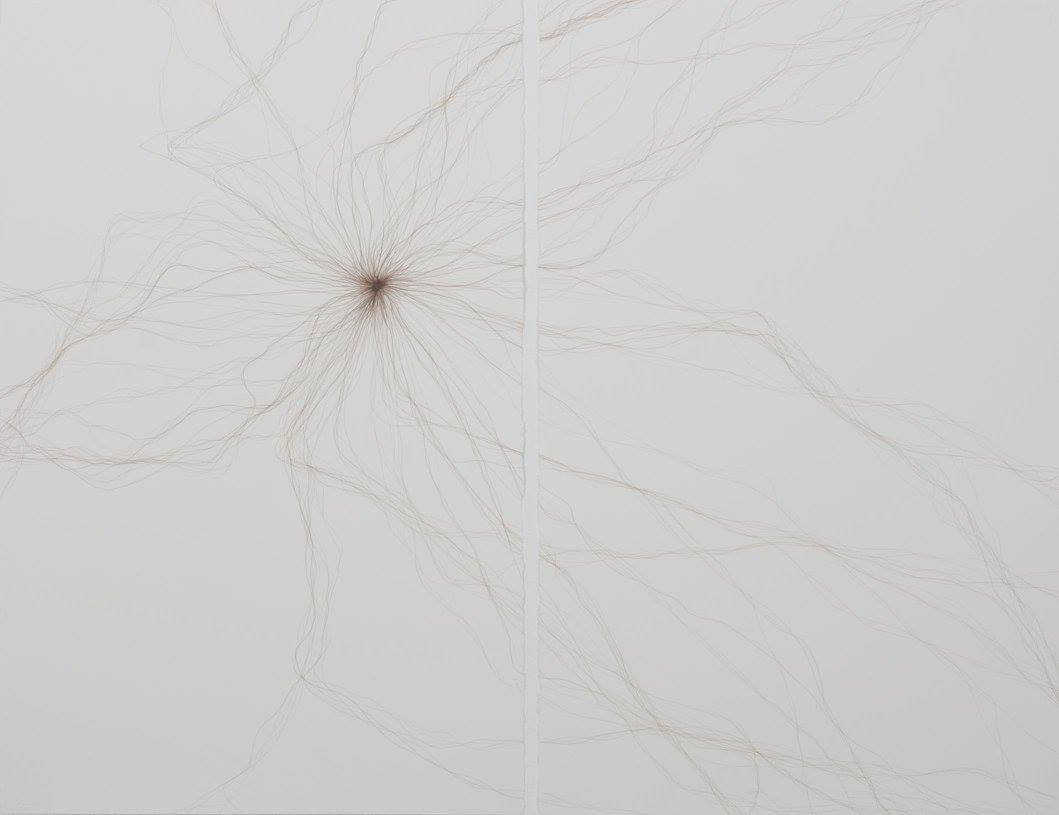
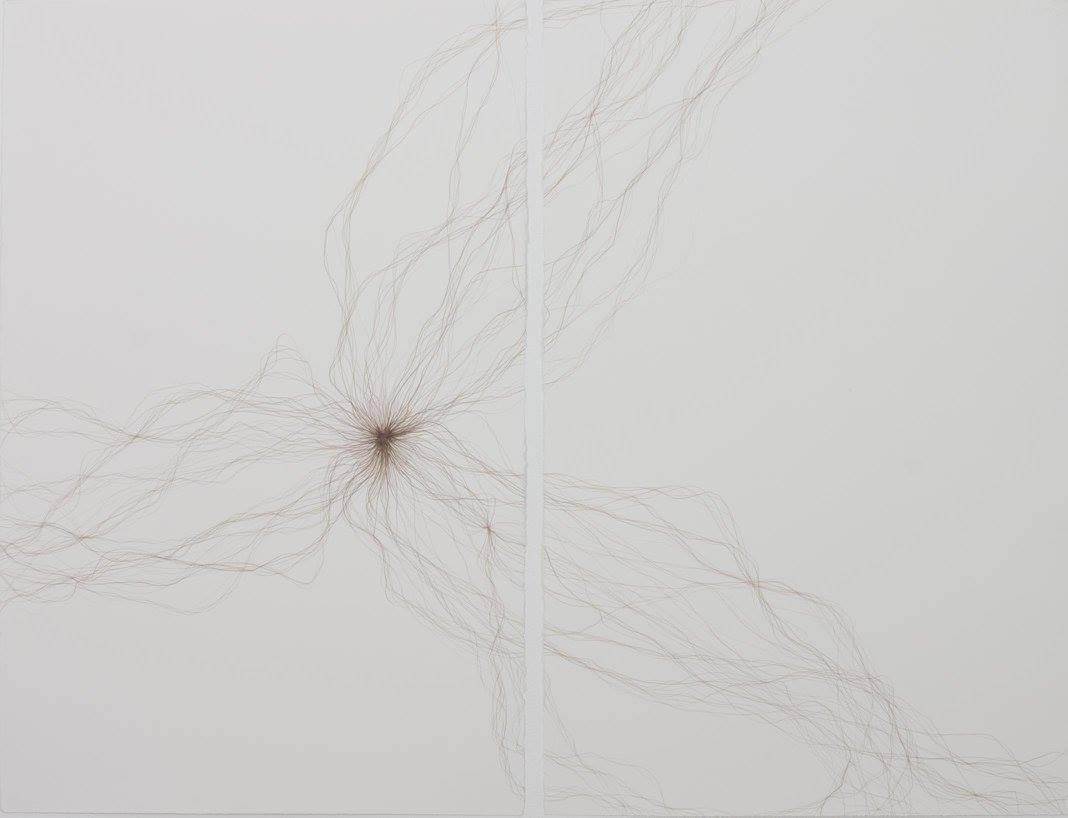
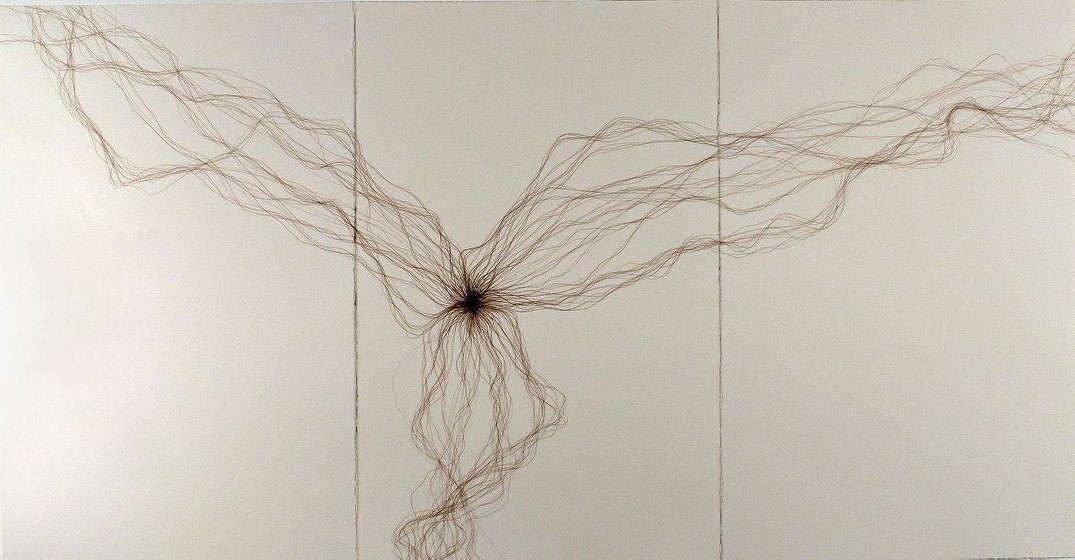
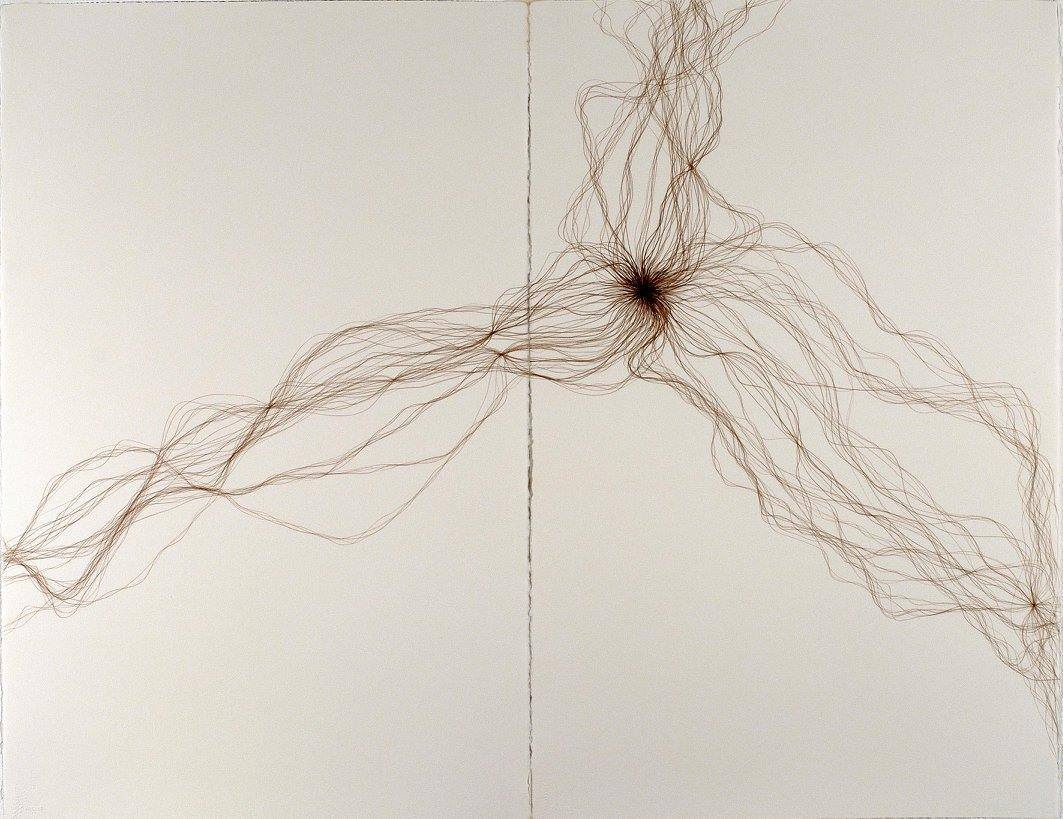
certain of these works offer us a chance for perhaps a closer approach to his personal sphere, almost to his physical being. We might talk about a proximity that is exposed to the gaze, in a cycle of works on paper under a single title: Respiro (Breath). The large sheets of paper lined up in overlaid rows are crossed by bundles of sinuous lines that flee to the margins. The observer is attracted by their slenderness and, at the same time, their evidence, deceptively like filaments, or hairs embedded in applied onto the paper. The sign is actually obtained with ink, but – as the artist explains – the result is possible only through particular physical and mental preparation: “To obtain this sign, it takes a gesture done with a special brush, with long bristles, dipped in ink. The ink held by the bristles is deposited with a wide, flowing, continuous gesture. Breathing is important: the exhalation accompanies the whole trajectory of the sign on the paper, and the air contained in the lungs is released in synchrony with the release of the ink from the bristles. The lines that cross the sheet have their own shape. Those modulations can be compared to the signs made by a seismograph: the point of the brush records an inner state, just at the tip of the seismograph records telluric movements, or the encephalogram records brain activity.” It is breathing, then, its rhythm, that determines the fluid movement of the lines that cross the paper.
Respiro. Ink on paper, 6 sheets 66×101 cm each, 2009 [D0391]
Respiro. Ink on paper, 6 sheets 66×101 cm each, 2009 [D0392]
Respiro. Ink on paper, 6 sheets 66×101 cm each, 2009 [D0393]
The idea of center as origin, the place from which infinite directions depart, or the infinitely small vanishing point, is found in the iron scultpure Omphalos,
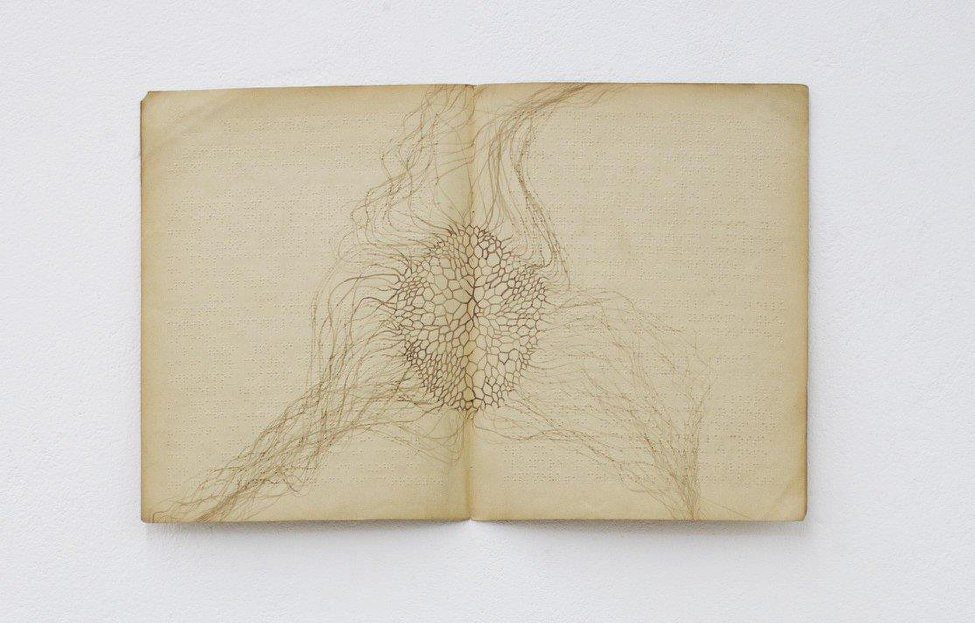
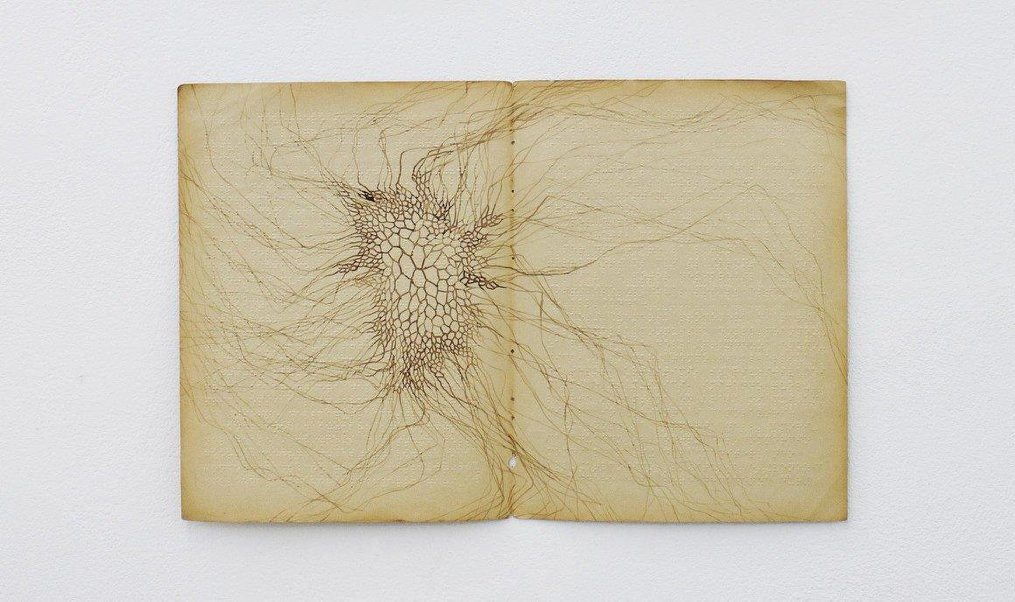
a series of ink drawings with the same title, and La freccia che colpisce il bersaglio vola per sempre, a sculpture in white terracotta whose four parts are, in turn, composed of a series of concentric sub-parts sloping towards the inside to form a sort of visual vortex. Omphalos is a word from ancient Greek meaning “navel,” but also umbilical cord, the center of the Earth. The omphalos is the center of the human body, but it is also, significantly, a scar that bears witness to the moment in which we were separated from the maternal body that hosted and generated us; it is the tangible sign of a separation, but also of the conquest of an independent life. The reference to the many meanings of this word emerges in two sculptures, one in iron and one in graphite, and their related drawings. In the sculptures the movement of expansion that starts at the center necessarily encounters a limit at the borders of the object, while in the drawings the lines that spread out from the center suggest a potentially infinite movement. Again in these works, it is not so much the natural, the living that is shown and represented. As the artist remarks in his writing, instead it is a question of “to act as nature would, which is also typical of the alchemical process. The alchemist is he who sets out not to reproduce a natural phenomenon in the laboratory, but to pro-duce processes of transmutation according to the ways of nature, attuning soul and body to its way of proceeding”.
Omphalos. Ink on paper, 2 sheets 66×102 cm each, 2006/2007 [D0042]
Omphalos. Ink on paper, 2 sheets 66×102 cm each, 2006/2007 [D0047]
Omphalos. Ink on braille paper, 51×34 cm, 2006/2007 [D0122]
Omphalos. Ink on braille paper, 51×34 cm, 2006/2007 [D0123]
Omphalos. Ink on paper, 3 sheets 66×102 cm each, 2006/2007 [D0039]
Omphalos. Ink on paper, 2 sheets 66×102 cm each, 2006/2007 [D0040]
In the works on paper from this period, with a dizzying shift of perspective, the artist’s gaze is directed into a compositional plot that tends to erase distance,
in a near mingling, as if to fully know its innermost structure. But this is not just a case of “learning to see” things as they are intertwined in the plot of nature; it means feeling a sense of belonging to that same plot. This is what happens in Pittura per ciechi (Painting For the Blind), a series di gouaches made on the pages of old Natural History textbooks in Braille, or in works like Bianco/Nero (White/Black) Bianco/Rosso (White/Red), where the shortening of the distance between the eye and the represented object produces effects of distortion, overlaps of figures that appear on the single sheets, disrupting their order: each of them thus appears as a fragment of something whose overall view has been lost.
Bianco/Nero. Gouache on paper, 36 sheets 25×35 cm each, 2007 [DG0047]
Bianco/Nero. Gouache on paper, 36 sheets 25×35 cm each, 2007 [DG0046]
Bianco/Nero. Gouache on paper, detail, 2007 [DG0046]
Bianco/Nero. Gouache on paper, 12 sheets 25×35 cm each, 2007 [DG0058]
Bianco/Nero. Gouache on paper, 3 sheets 25×35 cm each, 2007 [DG0050]
Bianco/Nero. Gouache on paper, 3 sheets 25×35 cm each, 2007 [DG0051]
In the works on paper from this period, with a dizzying shift of perspective, the artist’s gaze is directed into a compositional plot that tends to erase distance,
in a near mingling, as if to fully know its innermost structure. But this is not just a case of “learning to see” things as they are intertwined in the plot of nature; it means feeling a sense of belonging to that same plot. This is what happens in Pittura per ciechi (Painting For the Blind), a series di gouaches made on the pages of old Natural History textbooks in Braille, or in works like Bianco/Nero (White/Black) Bianco/Rosso (White/Red), where the shortening of the distance between the eye and the represented object produces effects of distortion, overlaps of figures that appear on the single sheets, disrupting their order: each of them thus appears as a fragment of something whose overall view has been lost.
Bianco/Rosso. Gouache on paper, 36 sheets 25×35 cm each, 2007 [DG0049]
Bianco/Rosso. Gouache on paper, 36 sheets 25×35 cm each, 2007 [DG0048]
Bianco/Rosso. Gouache on paper, detail, 2007 [DG0048]
The dialectic relationship between order-disorder, expansion-contraction, density-rarefaction, like the generative vitality of the form, are elements also found
in many sculptures in iron or terracotta made by the artist starting in 2006: Metameria (Metamerism), Come fosse in ascolto (As If Listening), Latte nero (Black Milk), Odradek, insiemi instabili (Unstable Sets), Fiori (Flowers), Vayu, Omphalos, La freccia the colpisce it bersaglio vola per sempre (The Arrow that Strikes the Target Flies Forever). But also in very recent works, like the installation created for the Museum of Modern Art of Ascona, entitled Memoriale volubile (Fluctuating Memorial). All of them are composed of a series of similar but not identical elements, in terms of form and size, whose number and arrangement varies, also in keeping with the place where they are positioned. In all these works, the unavoidable relationship with space makes them take on different aspects, demonstrating a flexibility, a capacity to adapt, that is part and parcel of the generative will that dwells inside them. Their components tend to multiply in a movement that without compromising individuality unites them in an ongoing metamorphosis.
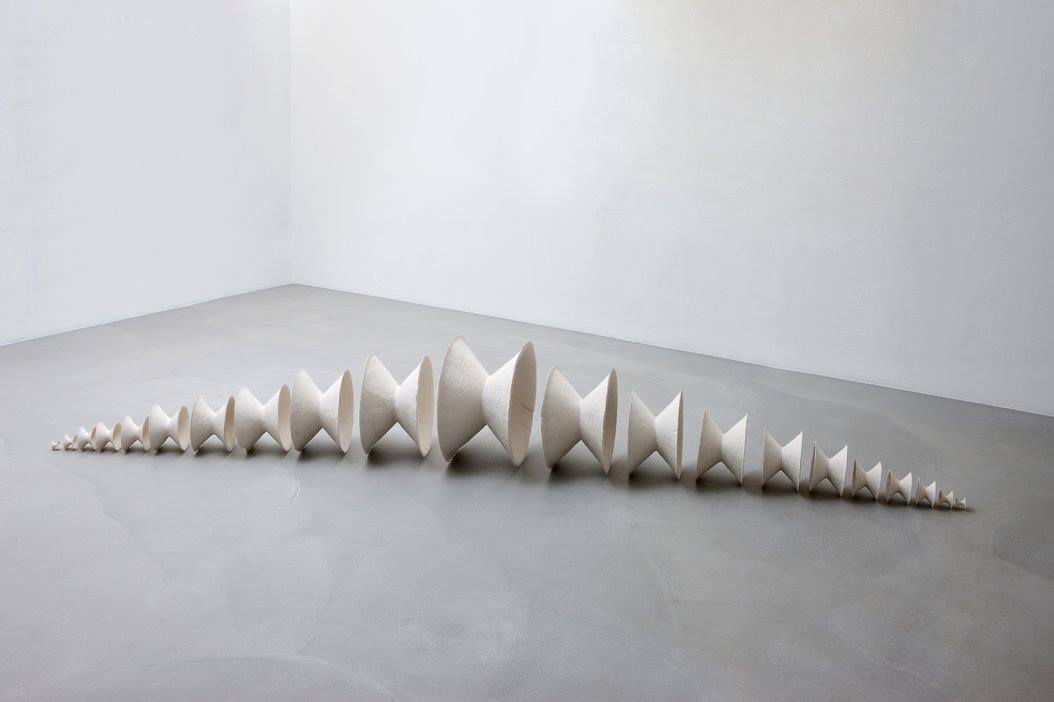
Both Metameria, an iron sculpture composed of 23 parts, and Come fosse in ascolto, made of 21 parts in white terracotta, are organized on a plane, on a longitudinal axis, in order of decreasing size, symmetrical to a central element, or “in a rhythm of crescendo and diminuendo,” as the artist says, borrowing terms from the language of music. Both focus on the question of symmetry and its disruption, the dialectic between order as a principle of stability and disorder as a generative factor. Besides, both suggest similarities with imaginary organic structures, although there is no actual intention of mimicking reality: the point is not to represent – in the sense of re-producing – anything that exists, but to bring into being forms that reveal their shared belonging to an imaginary organic world. In Come fosse in ascolto there is a balance between the single parts that almost has a musical shape: from the low central note of the central element to the gradual ascent of pitch, in two opposite directions, towards the ends. The reference to sound in the title can also be connected with the form of the elements that make up the sculpture, which recall strange auricles and suggest the idea of a mysterious listening device.
Come Fosse in Ascolto. Terracotta, 21 elements 550x55x30 cm approx., 2007 [S0020]
La Freccia che Colpisce
il Bersaglio Vola
per Sempre
The idea of center as origin, the place from which infinite directions depart, or the infinitely small vanishing point, is found in the iron scultpure Omphalos,
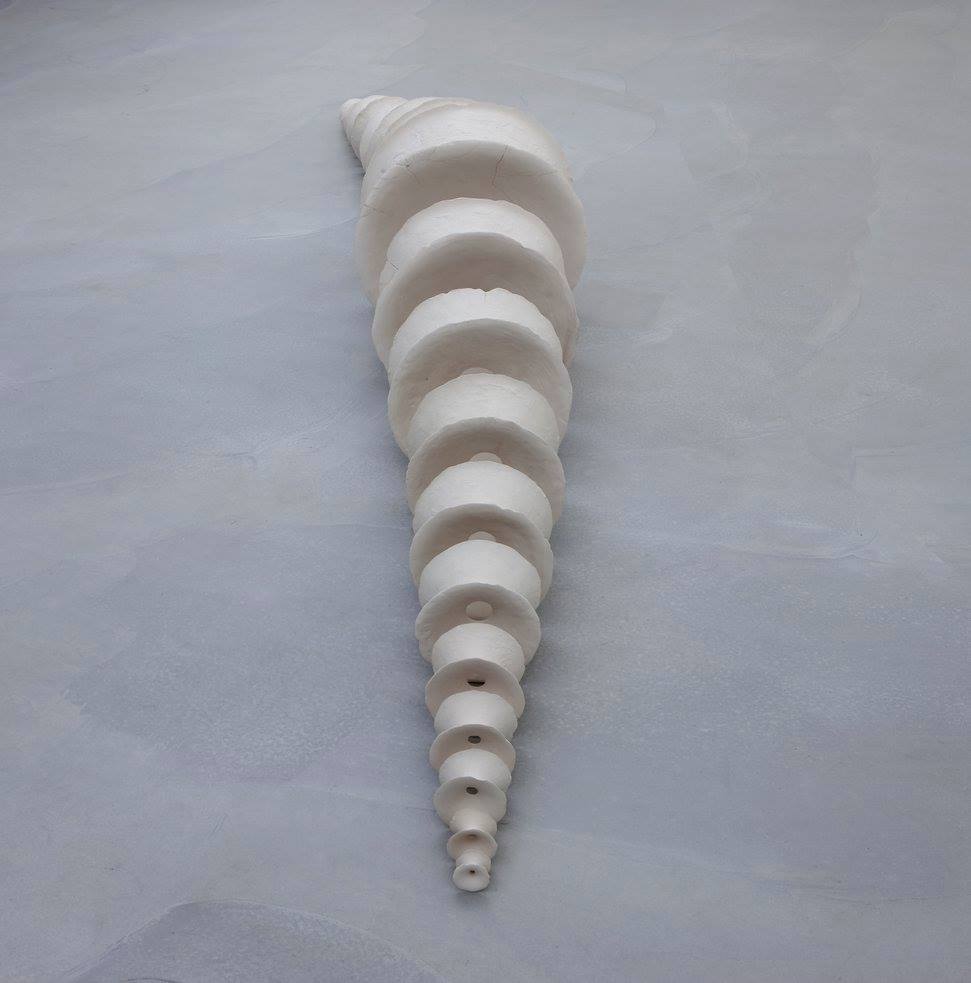
a series of ink drawings with the same title, and La freccia che colpisce il bersaglio vola per sempre, a sculpture in white terracotta whose four parts are, in turn, composed of a series of concentric sub-parts sloping towards the inside to form a sort of visual vortex. Omphalos is a word from ancient Greek meaning “navel,” but also umbilical cord, the center of the Earth. The omphalos is the center of the human body, but it is also, significantly, a scar that bears witness to the moment in which we were separated from the maternal body that hosted and generated us; it is the tangible sign of a separation, but also of the conquest of an independent life.
In La freccia che colpisce il bersaglio vola per sempre the concentric circles attract the eye, sucking the gaze towards an infinitely small inner point, triggering a visual vortex. This tiny point is not conceived as the center or the extremity of the world, just as it was not seen as such in Omphalos. Instead, we can say that it is precisely “this vortex,” “this rotation” in a rhythmical movement of being and non-being, of visible and invisible that belongs to all things, and is seen as the extreme meaning of the world. The relationship between these works emerges, then, as tension, a struggle between two poles: not as laceration, but as the intense intimacy, the mutual belonging of the two rivals.
La Freccia che Colpisce il Bersaglio Vola per Sempre. Terracotta, 4 elements variable dimensions, 2007 [S0021]
La Freccia che Colpisce il Bersaglio Vola per Sempre. Paper model, 2007 [S0021]
La Freccia che Colpisce il Bersaglio Vola per Sempre. Terracotta, 4 elements variable dimensions, 2007 [S0021]
The idea of center as origin, the place from which infinite directions depart, or the infinitely small vanishing point, is found in the iron scultpure Omphalos,
a series of ink drawings with the same title, and La freccia che colpisce il bersaglio vola per sempre, a sculpture in white terracotta whose four parts are, in turn, composed of a series of concentric sub-parts sloping towards the inside to form a sort of visual vortex. Omphalos is a word from ancient Greek meaning “navel,” but also umbilical cord, the center of the Earth. The omphalos is the center of the human body, but it is also, significantly, a scar that bears witness to the moment in which we were separated from the maternal body that hosted and generated us; it is the tangible sign of a separation, but also of the conquest of an independent life. The reference to the many meanings of this word emerges in two sculptures, one in iron and one in graphite, and their related drawings. In the sculptures the movement of expansion that starts at the center necessarily encounters a limit at the borders of the object, while in the drawings the lines that spread out from the center suggest a potentially infinite movement. Again in these works, it is not so much the natural, the living that is shown and represented. As the artist remarks in his writing, instead it is a question of “to act as nature would, which is also typical of the alchemical process. The alchemist is he who sets out not to reproduce a natural phenomenon in the laboratory, but to pro-duce processes of transmutation according to the ways of nature, attuning soul and body to its way of proceeding”.
Akasha è l’Elemento Etere. Di natura composita, la qualità che lo caratterizza è la pervasività. Il suo colore è l’insieme di tutti i colori. Il cerchio la forma che gli attiene.
Suo chakra è Vishuddi localizzabile in corrispondenza del plesso cervicale. Il suo mantra è HAM. L’udito il senso da quest’Elemento governato. Quello delle emozioni è l’ambito cui esso sovrintende. Presiede inoltre al funzionamento delle corde vocali e delle orecchie. L’area che va dal centro fra le sopracciglie all’apice della calotta cranica è quella sulla quale è orientata l’attenzione del praticante durante Tattwashuddhi. Prajna – conoscenza metafisica – è facoltà da Akasha governata. Anandamayakosha è il suo ‘corpo’ – coro di beatitudine e di coscienza sovramentale -. Vyana è il suo soffio vitale, corrente pranica la cui energia pervade l’intero essere. Esso non sottostà ad alcuna direzione indicata dalla Rosa dei Venti. Tattwa è anche un cammino, un percorso: ogni opera individua una tappa all’interno di esso.
Akasha. Fresco transferred to canvas, 2002 [TW0004]