‘Il nome dell’arco’, an environmental installation presented in 1983 at the Lenbach museum in Munich.
The arbitrary and unprogrammable nature of art is the context within which this work takes form as a pure event: twelve large panels bearing luminous marks are arranged to form a dodecagonal space at the centre of which stands a massive tree branch, curved into the arc of a bow and covered with gold leaf. In the penumbra of the environment, the transparency of the coloured marks on the panels, a form of luminous multicoloured bieroglyphs, interacts with the gleaming gold of the bow, while a continuous sound, a kind of low, indistinct bum, emanates from an unidentifiable source, almost as if it were the subtle alien voice of the coloured motifs. The setting, pervaded by a subtle sacred atmosphere, which is implicit, interior and in no way made manifest, seems almost like a place of worship abandoned by a long defunct deity.
Il Nome dell’Arco. Environmental Installation, Munich, Lenbach Museum, 1983 [PE0006]
Il Nome Dell’Arco. Window Decals, 2,4×3,6 cm each, 1983 [FT0006b]
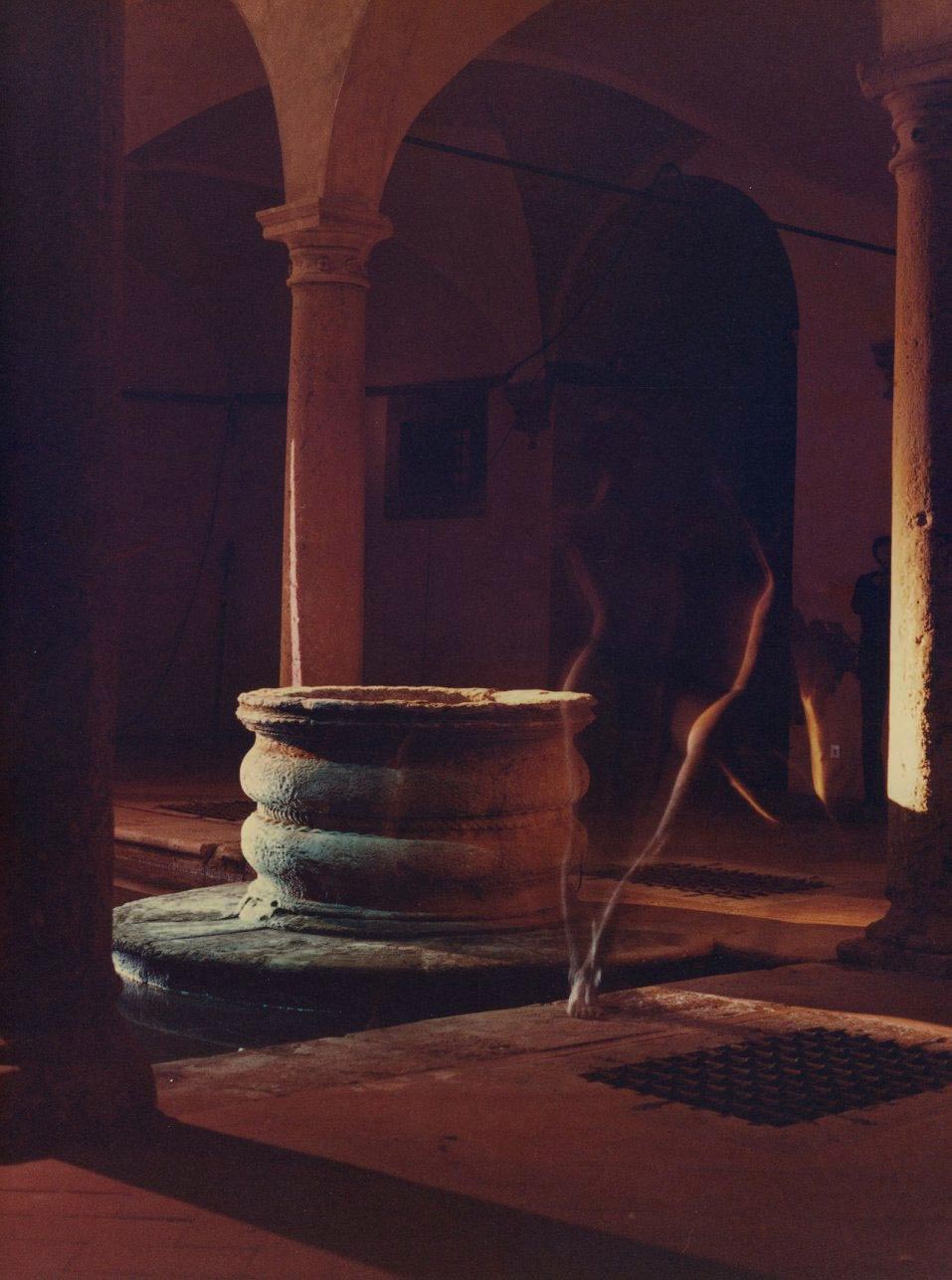
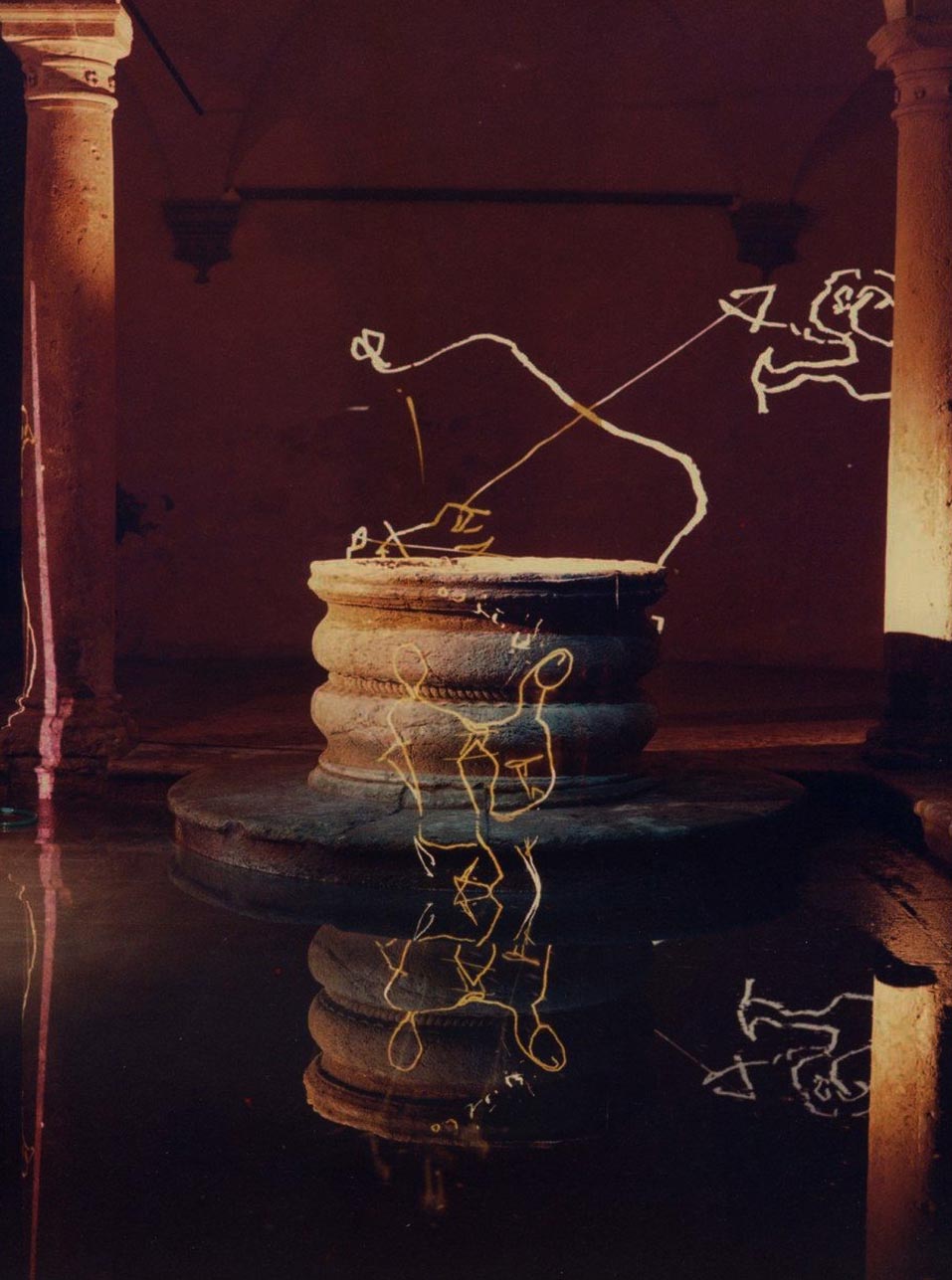
In Volterra, the fifteenth-century cloister of then Pinacoteca serves as a closed domain, perfectly self-contained in its classical proportions.
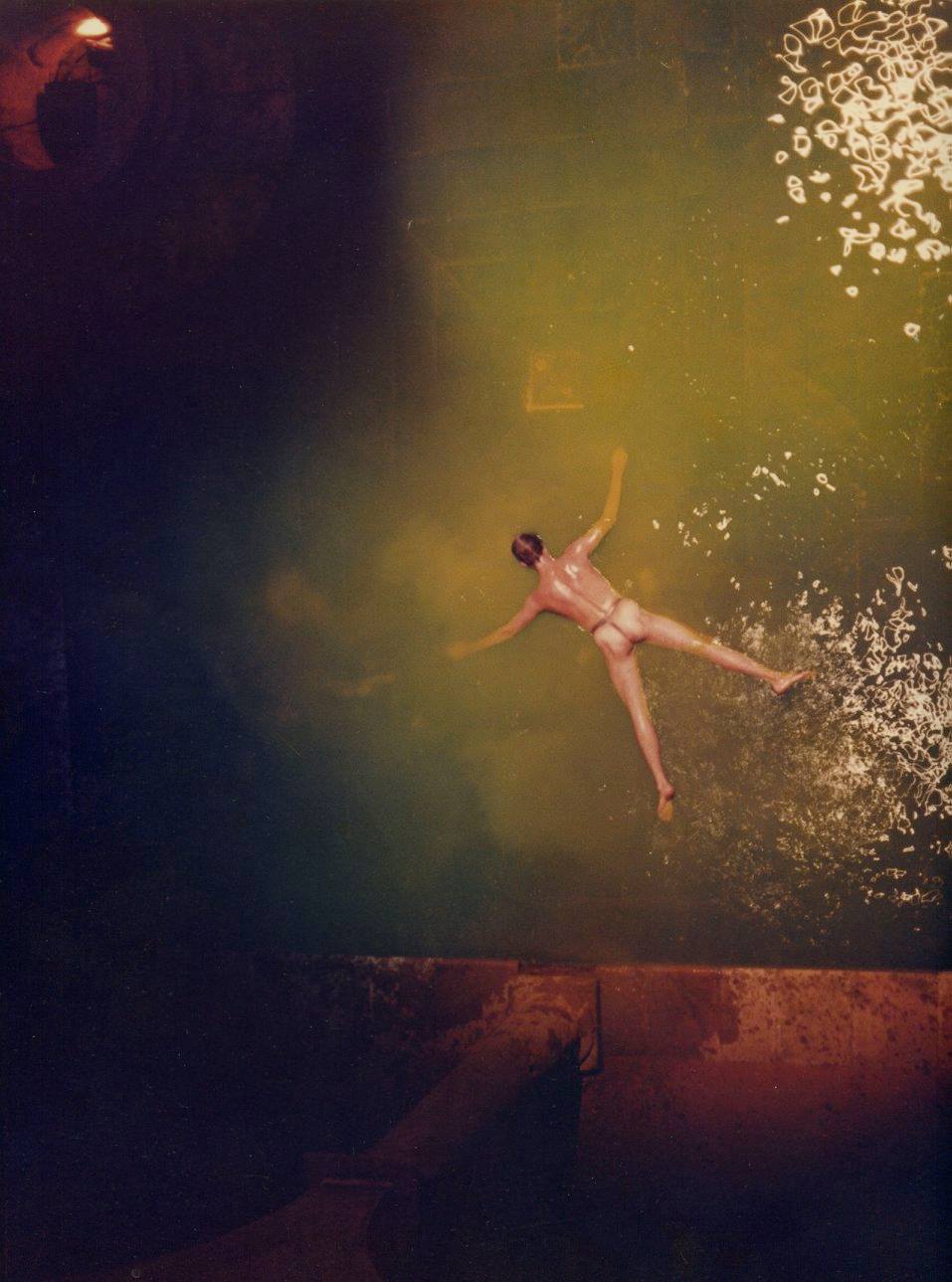
Across this space passes the body of a dancer (Gastavo Frigerio once more) exploring the space, conforming and reacting to a series of luminous marks and drawings laid down by the artist. As in the Villa Ponti event, the architectural features of the setting are emphasised and then anihilated through the imposition of illusory perspectives. The sound accompaniment delineates a second domain lying below the visible setting – an unseen subterranean realm exerting an influence on the dancer which he is unable to resist. The centre of the cloister coartyard, flooded with water, serves as a reflecting mirror which multiplies the luminous traces, distorting and disarticulating the flow of events: the dancer’s body interacting with the reflecting surface to the point of merging with its reflected image. Thus the mobile language of the body, an element of change and mutability, combines with the static structure of the setting, subverting and transforming it. The body preserves its being through a process of change and, in moving, opens up a void in front of itself, the void of its own profile, strewing the signs of its passing and recognition. What is offered is an image of time marked out by the body, as opposed to the absolute immobile time of the fixed drawings, the statis of rule-bound structure. The seemingly absolute authority of the current state of affairs is revealed as contingent, by no means eternal, established historically and therefore somethings witch may be dis-established.
Notturna. Environmental and sound installation-performance, Volterra, Pinacoteca, 1983 [PE0014]
Non Ombra (Not Shadow) Intatto Fiore (Intact Flower) Figurali attestazioni (Figural Testaments)
These three videos form a trilogy, in effect,
marked by vivid shared elements in terms of formal choices and the presence of an inner, almost intimate tone that is utterly absent in the other videos that are part of Restlessmatter.net
Non Ombra (Not Shadow)
Intatto Fiore (Intact Flower) Figurali attestazioni (Figural Testaments)
These three videos form a trilogy, in effect,
marked by vivid shared elements in terms of formal choices and the presence of an inner, almost intimate tone that is utterly absent in the other videos that are part of Restlessmatter.net
Non Ombra (Not Shadow) Intatto Fiore (Intact Flower)
Figurali attestazioni (Figural Testaments)
These three videos form a trilogy, in effect,
marked by vivid shared elements in terms of formal choices and the presence of an inner, almost intimate tone that is utterly absent in the other videos that are part of Restlessmatter.net
This video takes its cue, as in other cases, from aninstallationof the same name: a set of fragile, threadlike works of architecture arranged without apparent order in space,
which seem to respond to a pure impulse of expansion. These are pile dwellings, as the artist calls them, of uncertain stability, a precarious relationship with the ground. Archetypes of buildings that from one moment to the next might take flight. The gauze that covers some of them might suggest the idea of illness, but also of shelter, the necessary protection of something that is fragile and precarious..
/ Elena Scardanelli interviews Ferruccio Ascari
This video takes its cue, as in other cases, from an installation of the same name: a set of fragile, threadlike works of architecture arranged without apparent order in space, which seem to respond to a pure impulse of expansion. Elementary edifices of uncertain stability that have a precarious relationship with the ground. Archetypes of buildings that from one moment to the next might take flight. Let’s start with the title: Luogo Presunto. Therefore an imaginary place, whose existence is not assured, with the same consistency as a mirage, a dream. In this work of yours I seem to sense a reference, starting with the title, to Borges and his poetics, especially an anthology of poems published in Italy under the title Carme Presunto. Does this intuition have any basis? Yes, you’re right… I’ve been rereading Borges, precisely in the last few days. I was struck by what he writes about poetry, in one of his texts. I can read it for you: “all poetry is mysterious; no one knows about everything it is given him to write. The dreary mythology of our age speaks of the ‘subliminal self’ or, what is even less beautiful, of the ‘subconscious’; the Greeks invoked the Muse, the Hebrews the Holy Spirit – it amounts to the same thing.” I think this statement of Borges can be extended to art as well, or at least to how I understand the impulse that lies at the origin of the artistic act. For me, it is something mysterious, a sort of calling; you don’t know where it comes from, you feel obliged to respond to it, as if you couldn’t do otherwise. Borges’ poetics stems from visions, memories, portents that have the charm of purely imaginary situations, disconcerting mirages: in an infinite perspective, a range of sensations and images that seem to belong more to the material of which dreams are made than to reality. It is the same material of which this work of yours seems to be made, both the installation and the video you have made of it. Could you talk about this? There are images, arriving from who knows what distances, that take up residence in my head and remain there, as if incubating, perhaps for years. Usually I let them be, I avoid “touching” them, since I know they need time. Then one day the hands, gripped by a sudden urgency, start to move as if of their own accord, with unusual confidence… then those mental images, with a speed that surprises even me, take on form. A sort of utterly mental fixation I haven’t driven away, but haven’t particularly nurtured either, suddenly takes form. I start to hammer the metal wire close at hand on the anvil, I make four vaguely straight bars, rustically welding them together, and they take on the form that perhaps awaited them: a palafitte. Faced with the first of these pile dwellings, which would then become part of Luogo Presunto, it was like being in front of a sudden yet familiar presence. A slender, hesitant presence: you touch it and it wobbles. It continues to tremble, taking a while to settle into stillness. I think: I want to film this. Even when it is still, it continues to speak of all its instability. Why the palafitte? Maybe precisely for this presumed instability, its apparent precariousness, this kind of prehistoric architecture has fascinated me since childhood. A house between earth and sky. A suspended shelter, to avoid contact, to protect perhaps more than a solid construction with a foundation, well rooted in the earth. The materials of Luogo Presunto are iron and cotton gauze: what relationship develops between two materials of such a different nature? Gauze is the wound, the burn to care for, to protect. Gauze is illness, protection, the hospital… but it is also transparency, levity, the caress. You told me that as a child you fell into a large vessel full of boiling water, and the serious burns all over your body made you linger between life and death for several days… it isn’t hard to imagine that it was precisely gauze that protected your bed during convalescence, your body as it struggled to stay alive. I don’t know to what extent that episode can be seen in relation to the materials I used in Luogo Presunto… I can’t rule out the connection. In any case, when I began to work on this project, those slender works of architecture were like wobbly skeletons, made of wire and air… the gauze came later, by intuition, as if it came down from the sky to give a body to those skeletons, without adding weight, or an opacity they could not have stood. So it is not by chance that in the video the gauze rains down precisely from the sky onto those structures… I’m afraid that what we call “chance” is simply what we don’t understand, or whose origin we have forgotten.
Through a series of sequences edited at a fast pace, marked by a metronome, the film documents the phases of the making of Luogo Presunto, revealing its constituent elements.
The video takes its cue from an installation of the same name by Ferruccio Ascari from 2012, composed of multiple elements: a series of terracotta urns,
different in size and form, containing remains that are hard to identify.
Perhaps bones of beings with an unspecified and unspecifiable nature. The urns were then sealed by the artist. Their content thus became secret, invisible, but before completing this operation and making them definitively inaccessible inside, photographs were taken: partial images, details of what the urn contains. Starting with these images, the viewer begins an imaginative path: a flow of mental associations that is an integral, essential part of this mysterious work that seems to harbor an initiatic meaning. The video made starting with this work is also a voyage, in effect. A voyage of a visual nature inside unspecified cavities, in a hypothetical underground, a deep repository that stores the remains of everything, where each item is subject to an incessant process of transformation and germination.



 [vc_images_carousel images=”1286,1287,1288,1289,1290,1291″ img_size=”full” onclick=”link_no” hide_pagination_control=”yes”]


